Why are forward-thinking companies making the switch to renewables
What Is Green Electricity?
Introduction
Electricity is one of those business essentials that rarely gets much attention. You turn on the lights, cool the office, operate your equipment, and pay the bill at the end of the month.
However, where that electricity comes from is becoming increasingly important. Customers, investors, and larger business partners are paying closer attention to environmental performance. This has encouraged more companies to consider green electricity as part of their long-term business plans.
The good news is, businesses today have more options than ever to support a lower-carbon future. In this guide, we explore what green electricity is, why it matters for businesses in Singapore, and how companies can take practical steps towards more sustainable energy choices.
Key Takeaways
-
Green electricity allows businesses to support renewable energy without necessarily changing their existing electrical infrastructure.
-
Businesses in Singapore can explore retail electricity plans, Renewable Energy Certificates (RECs), onsite solar systems or, in the future, imported low-carbon electricity.
-
The right solution depends on your business's electricity usage, premises, sustainability goals and reporting requirements, rather than a one-size-fits-all approach.
-
Green electricity can support Scope 2 emissions reporting and help businesses respond to growing sustainability expectations from customers, investors, and business partners.
-
Working with an experienced electricity retailer can make it easier to choose a solution that fits your operations today while supporting your longer-term sustainability plans.
What is green electricity? ⚡️
Green electricity refers to electricity generated from renewable sources that naturally replenish over time and generally have a lower environmental impact than fossil fuels.
Common sources include:
- Solar energy generated from sunlight
- Wind energy
- Hydropower generated from moving water
- Geothermal energy drawn from heat beneath the Earth’s surface
- Biomass produced from suitable organic materials
Unlike fossil fuels such as coal and natural gas, these sources are not permanently used up when electricity is generated. This means they can continue supporting our energy needs over the longer term.
However, the environmental impact can vary between projects. Factors such as location, scale, land use, and how the project is managed can affect whether a renewable energy source is considered fully green.
Is green electricity the same as renewable energy? 🤔
Not exactly.. Put simply, all green electricity comes from renewable sources, but not all renewable energy is necessarily considered green.
Here are their core differences:
-
Form of energy: Renewable energy can include electricity, heat, biofuels and mechanical power. Green electricity refers specifically to electricity generated from renewable sources and supplied to the grid.
-
Environmental impact: Not every renewable energy project is considered fully ‘green’. For example, large hydropower dams may generate renewable electricity but can also disrupt river ecosystems, fish habitats, and surrounding communities.
-
Where they overlap: Solar, wind, and geothermal energy are commonly considered both renewable and green because they replenish naturally and generally have a lower environmental impact than fossil fuels.
How businesses in Singapore can access green electricity
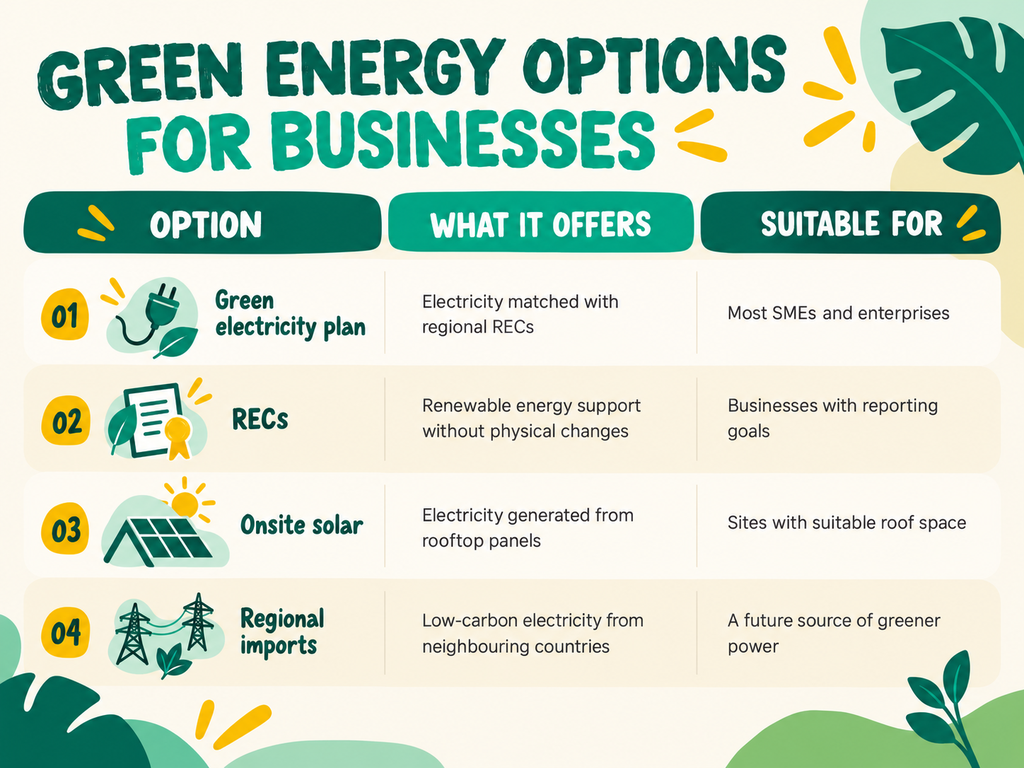
Businesses in Singapore can invest in green electricity in several ways, depending on their premises, energy use, and corporate sustainability goals.
1. Green Business Electricity Plans
Under Singapore’s Open Electricity Market (OEM), businesses can choose electricity retailers that offer green electricity plans instead of remaining on the default electricity arrangement.
At Flo Energy, the plans we offer differ according to business size and electricity use. Small and medium enterprises (SMEs) using less than 20,000 kWh per month can choose from straightforward fixed-rate small business electricity plans, with 100% of their electricity usage matched with regional Renewable Energy Certificates under the Flo Commitment.
Larger enterprises using more than 20,000 kWh per month can choose from fixed, pool, or hybrid business electricity plans, tailored to your past usage, load profile, and operational needs. This gives businesses a practical way to invest in sustainability without changing their existing setup.
2. Renewable Energy Certificates (RECs)
Renewable Energy Certificates, or RECs, are used to show that a certain amount of electricity has been generated from renewable sources and supplied to the grid. Since electricity from different sources is mixed together once it enters the grid, RECs give businesses a practical way to support renewable generation and account for the environmental value of that electricity.
With Flo Energy, 100% of a business’s electricity usage is matched with regional RECs through the Flo Commitment. We will also redeem the certificates on your behalf, with the RECs sourced through recognised registries and aligned with Singapore Standard 673.
3. Onsite solar energy systems
Businesses with suitable rooftop space can install solar panels and generate part of the electricity they use on site. This is often a practical option for warehouses, factories, industrial facilities and larger commercial buildings that use a lot of electricity during the day.
Generating solar power for your business can reduce the amount of electricity drawn from the grid, although the results will depend on factors such as roof size, shading, building ownership, and daily consumption patterns.
If you do not want to, or are unable to, pay the full installation cost upfront, you may also explore arrangements such as a Solar Power Purchase Agreement (PPA). Under this arrangement, a provider installs, owns and maintains the solar system, while your business purchases the electricity it generates at an agreed rate for a set contract period. This can make onsite solar more accessible by reducing the need for upfront capital, though businesses should still review the contract length, pricing terms, and site requirements carefully.
4. Regional Renewable Energy Imports
Singapore has limited space and natural resources for generating renewable energy at scale. As a result, importing low-carbon electricity from neighbouring countries is becoming an important part of the country’s energy transition.
These imports may include electricity generated from renewable sources such as solar and hydropower. Singapore has already started importing hydropower from Lao PDR through Thailand and Malaysia, and the government aims to import around 6 GW of low-carbon electricity by 2035.
Over time, these projects could give businesses access to a wider supply of green electricity. However, the options available to individual businesses will depend on how the infrastructure, regulations, and electricity plans develop.
Reasons your company should make the switch
1. Sustainability Is Becoming a Business Expectation
Going green is no longer something only large corporations talk about. Across many industries, customers, investors, business partners, and even employees are paying closer attention to how businesses manage their environmental impact.
This shift is happening alongside national initiatives such as the Singapore Green Plan 2030 and the country's net-zero ambitions. While every business will approach sustainability differently, many are looking at practical ways to reduce their carbon footprint without disrupting day-to-day operations. For companies that rely heavily on electricity, choosing green electricity is often one of the more accessible places to start.
2. Support Environmental, Social, and Governance (ESG) Reporting
Purchased electricity is often a major source of Scope 2 emissions, so changing how it is sourced can affect what a business reports under the environmental pillar of ESG.
The important part is having evidence behind the claim. RECs should show how much electricity was matched and that the certificates were retired, while onsite solar should track how much electricity was generated and how much grid use it replaced. Your business electricity plans should also provide clear documentation on the renewable energy component.
This creates a stronger audit trail and makes it easier to explain emissions reductions to investors, clients, and procurement teams.
3. Helps businesses prepare for what's next
Energy and sustainability requirements are continuing to evolve. Procurement teams are increasingly asking suppliers about their environmental practices, reporting requirements are becoming more common, and businesses are under greater pressure to demonstrate measurable progress.
Switching to green electricity does not mean every company needs to invest in solar panels or completely overhaul its operations. Many businesses start with smaller, practical steps that fit their budget and operating model, then build on those efforts over time. Taking action early can make it easier to adapt as expectations, regulations, and energy options continue to develop.
A step-by-step guide to starting your green electricity journey
The process of making the switch does not have to be as complicated as you think. By reviewing your current energy use, setting clear goals and choosing a solution that fits your operations, you can take a more practical and manageable approach to the transition.
1. Build a clear picture of your electricity use
Start by reviewing at least six to twelve months of electricity bills rather than looking at a single month. This helps you see whether usage changes during busier periods, seasonal peaks, or longer operating hours.
You should also identify where most of the electricity is going. For example, air-conditioning systems, refrigeration, production equipment, lighting, and data facilities may contribute very differently to overall consumption. This information will help you estimate how much electricity needs to be covered.
2. Define the outcome you need
Before comparing providers, be clear about what the business is trying to achieve. A company preparing an ESG report may need reliable data and supporting documentation. A supplier working with multinational clients may need to meet specific procurement requirements. Another business may simply want to begin reducing the environmental impact of its electricity use.
These goals can affect the type of green electricity solution you choose. Defining your expected outcomes makes it easier to ask the right questions and helps you avoid paying for features that are not relevant to your needs.
3. Match the solution to your site and operating model
Once your goals are clear, consider what is practical for the way your business operates. A rented office may have limited control over the roof or electrical infrastructure, making a green electricity plan or REC-based option easier to implement. A warehouse, factory, or commercial property with suitable rooftop space may be able to consider on-site solar.
Key questions to consider include:
- Do you own or rent the premises?
- How much electricity do you use each month?
- Is most of your consumption during daylight hours?
- Do you need certificates or records for reporting?
- How much price certainty does the business require?
- Are you looking for a short-term starting point or a longer-term energy strategy?
4. Compare the full offer, not just the electricity rate
The lowest headline rate may not always be the most suitable option. Review what is included in the plan and what may come at an additional cost.
For an electricity plan, check the type and origin of the RECs, whether they are retired on your behalf, and what documentation you will receive. For a Solar PPA, review the contract length, agreed electricity rate, maintenance responsibilities, roof requirements, and what happens at the end of the agreement.
You should also look at billing clarity, account support, usage-tracking tools, and whether the solution can be adjusted as your operations grow. This gives you a more realistic picture of the overall value.
Frequently Asked Questions (FAQ)
Not always. The cost will depend on factors such as the plan structure, market conditions and the type of renewable energy support included.
For some businesses, the difference may be smaller than expected. It is also worth looking beyond the headline rate and considering what the plan includes, such as REC coverage, reporting support, and price certainty.
Signing up for a green business plan with Flo Energy takes less than 2 minutes online, but the full transfer process depends on whether your account is already contestable. Contestable accounts may be transferred within a few working days, while businesses that require meter conversion may need around 30 to 60 days.
Before making the switch, check your current contract for notice periods or early termination terms. Flo Energy can also guide you through the required documents and confirm when your new plan is expected to take effect.
No. Your electricity supply should continue as usual during the switch, as the physical power supply remains connected to the same national grid. The change mainly affects which retailer bills your business and the plan applied to your account.
Conclusion
Green electricity is no longer a niche option reserved for large corporations. Whether you are taking your first steps towards sustainability or strengthening an existing ESG strategy, there are now practical solutions to suit different business sizes, budgets and operational needs.
With more than 5 years of experience in Singapore's energy market, Flo Energy has helped businesses navigate changing electricity markets while delivering solutions that balance cost, operational requirements and sustainability goals. Whether you are exploring a green electricity plan, RECs or on-site solar through a Solar PPA, our team can help you identify an approach that works for your business.