What are they and how are they different from each other?
RECs vs Carbon Credits
Introduction
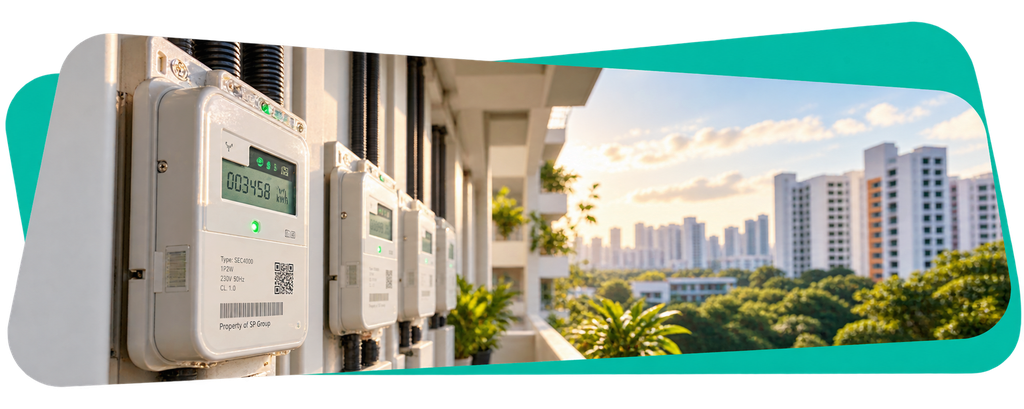
Smart meters are becoming a bigger part of how households in Singapore manage electricity. In fact, all 1.58 million household accounts in Singapore are expected to have smart meters installed by 2026 as part of the nationwide rollout of advanced meters.
With better access to energy data, homeowners can make more informed choices, reduce unnecessary consumption, and manage electricity more confidently. Below, we explore how these smart meters work for your home and how they support smarter energy decisions.
Key takeaways
-
A smart meter for your home allows you to better understand how and when electricity is being used.
-
This near-real-time usage data makes it easier for homeowners to identify energy-intensive habits and adjust daily routines.
-
Tracking consumption patterns can reveal hidden waste, such as standby power usage or inefficient appliances.
-
Small behavioural changes guided by smart meter insights can lead to meaningful long-term savings.
-
Smart meters also help households prepare for future energy management tools and smarter electricity planning.
What makes a meter 'smart'?
Traditional electricity meters are designed to record total electricity consumption over time. While they provide an accurate reading, they offer limited visibility into how usage changes throughout the day.
Smart electricity meters work differently by giving homeowners more timely and detailed access to energy information. Instead of only showing how much electricity has been used overall, they provide greater visibility into when and how consumption happens.
Key characteristics include:
-
Digital usage tracking: Unlike conventional meters that mainly display cumulative readings, smart meters record consumption digitally and capture usage information over shorter periods. This gives you a clearer picture of how electricity demand changes throughout the day.
-
Automatic reporting: Many smart meters facilitate automatic reporting, allowing usage information to be transmitted automatically instead of relying on manual collection. This helps reduce delays between consumption and reporting.
-
Better visibility into energy habits: Some smart systems can also support more connected energy management through communication with the wider electricity network. For homeowners, however, the biggest benefit is greater transparency into everyday electricity use.
Together, these features make a smart meter more than just a measuring device for your home. They’ll help you understand usage patterns more clearly and make more informed decisions about managing energy consumption.
How to read your smart meter?
Most smart meters for your home show electricity usage in kilowatt-hours, or kWh. This is the same unit used on your electricity bill.
To read your smart meter:
-
Check the display screen: Look for the main kWh reading. Some meters cycle through several screens, so wait a few seconds if the number does not appear immediately.
-
Note the total reading: The kWh number usually shows the total electricity used over time. This works like a running total.
-
Compare readings over time: To estimate usage, take one reading at the start of the day and another at the end. The difference tells you roughly how much electricity was used during that period.
-
Use the digital dashboard if available: If your meter is linked to an online portal or dashboard, check your usage there instead. This is usually easier than reading the physical meter and may show daily, hourly, or half-hourly trends.
-
Look at patterns, not just one number: A single reading tells you how much electricity has been used. Comparing readings helps you understand when usage is higher and whether your changes are working.
If you want an easier way to review your household energy usage, Flo Energy’s FlowSmart Dashboard can help you see your consumption patterns more clearly. Combined with Flo’s affordable home electricity plans, it gives homeowners a simpler way to understand their usage, manage costs, and support cleaner energy choices over time.
Tips for turning energy insights into lower consumption
Once you understand your energy patterns, the next step is to decide what to change. You do not need to overhaul your lifestyle. Start by matching the data to specific household routines, then make small adjustments that are easy to repeat.
1. Stagger appliance use
If your meter data shows regular spikes in the evenings, try spreading out some activities. You can run the washing machine earlier in the day, avoid using the dryer while cooking, or cool one room first instead of switching on multiple air-conditioners at the same time. This helps reduce periods of heavy demand without requiring you to stop using essential appliances.
2. Check standby power
If electricity usage remains high overnight or when no one is at home, check which devices are still running in the background. Common culprits include:
- Routers
- Set-top boxes
- Desktop computers
- Chargers
- Water heaters
- Dehumidifiers
- Appliances left on standby.
Try switching off non-essential devices for a few nights, then compare the change in your usage pattern.
3. Adjust how you use air-conditioning
In Singapore homes, air-conditioning can be a major contributor to electricity use. If your usage rises sharply whenever cooling is on, look at how long it runs and how many rooms are being cooled.
You can try setting a timer, increasing the temperature slightly, closing doors to keep cool air in, or using a fan together with the air-conditioner so the room feels comfortable without overcooling. The goal is not to avoid air-conditioning completely, but to use it more intentionally.
4. If one change works, turn it into a habit
Smart meter data is most useful when it helps you confirm what actually works. Instead of changing five things at once, test one adjustment for several days and compare the results.
For example, you might first reduce standby power, then adjust air-conditioning habits the following week. This makes it easier to see which change had the clearest effect. Once a habit reduces usage without affecting your comfort, keep it. Over time, these smal changes can help lower overall consumption in a way that feels practical and sustainable.
Get ready for a smarter, greener future with Flo Energy
Electricity costs can be affected by many factors beyond the household, including fuel prices, market conditions, tariffs, and global events. While we cannot control these wider changes, we can become more aware of how we use electricity at home.
With smart meters expected to be installed across household accounts in Singapore, it is worth learning how to read and interpret the data early. The sooner you understand your usage patterns, the easier it becomes to make small adjustments before costs rise further.
Make the switch early with Flo Energy, a trusted electricity provider in Singapore. Enjoy simple, fuss-free smart metering support, from free meter installation to zero maintenance on your end. Our smart meters for homes are also tested for accuracy, so you can be billed based on what you actually use rather than estimates. Together with our FlowSmart Dashboard, this gives you a clearer way to review your household energy consumption, understand usage patterns, and make smarter energy decisions over time.
We are still pending a full rollout of our household electricity plans. If you are interested, do express your interest by filling up a simple form in the link below!